
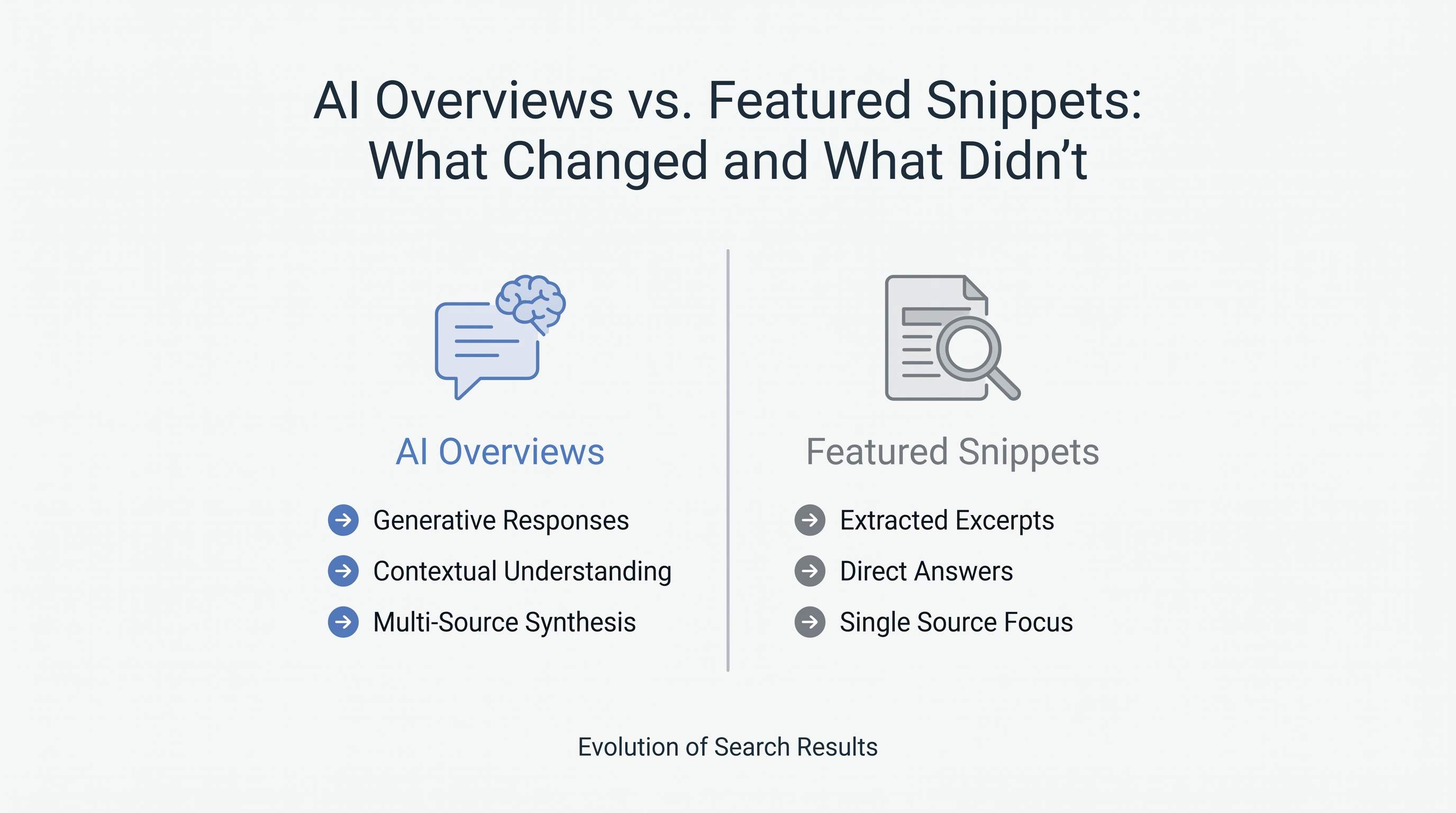
AI Overviews vs. Featured Snippets: What Changed and What Didn't
Search results look different than they did a few years ago. Where a tidy box once summarized the single best answer, a fuller AI-generated explanation now sits above the traditional blue links. The change has been dramatic enough that publishers, marketers, and everyday searchers all noticed.
The numbers explain the anxiety. Studies tracking the rollout of AI Overviews found that top-ranking pages lost up to 58% of their click-through rate when an AI Overview appeared for a query. That's no rounding error. It's a fundamental change in how attention moves across a results page.
But the story isn't as simple as "AI killed the click." To understand what really happened, compare the two features directly. This guide breaks down AI Overviews vs featured snippets: what changed, what stayed the same, and what still earns a click in 2026.
A Quick Refresher on Featured Snippets
Featured snippets debuted in the mid-2010s and quickly became the crown jewel of on-page SEO. Often called "position zero," a featured snippet is a box at the top of the results that pulls a concise answer directly from a single web page.
Key traits of a featured snippet:
- Single source. The answer is lifted verbatim from one ranking page, with a clear attribution and link.
- Formats vary. Snippets appear as paragraphs, numbered lists, bulleted lists, or tables.
- Extractive, not generative. Google selects existing text. It doesn't write anything new.
- Click incentive intact. Because the snippet is truncated, users often click through for the full answer.
For years, ranking in a featured snippet was a coveted win. It boosted visibility, lent authority, and still drove traffic. The searcher could see there was more to the story on the source page.
What AI Overviews Actually Are
AI Overviews, formerly Search Generative Experience or SGE, represent a different philosophy. Rather than extracting a single passage, Google's generative model synthesizes an answer from multiple sources, then presents it as a cohesive, multi-paragraph response at the top of the page.
Key traits of an AI Overview:
- Multiple sources. The overview blends information from several pages, listing supporting links off to the side or beneath the text.
- Generative, not extractive. The model writes the text fresh; it isn't copied from any one page.
- Conversational depth. Overviews often answer the main question plus anticipated follow-ups.
- Weaker click incentive. Because the answer is more complete, fewer users feel the need to click.
That last point is where the 58% CTR drop comes from. When a searcher gets a thorough, self-contained answer, the reason to visit a source page shrinks.
AI Overviews vs Featured Snippets: The Core Differences
Placed side by side, the AI Overviews vs featured snippets comparison reveals a shift in the intent behind the feature.
1. Extraction vs. Synthesis
A featured snippet says, "This page has the best answer—here's a taste." An AI Overview says, "Here's the answer we assembled for you." The former is a curator. The latter is an author.
2. One Winner vs. Many Contributors
Featured snippets reward a single page. AI Overviews cite a handful of sources, which spreads potential visibility across more sites but dilutes the traffic any one site receives.
3. Static Answer vs. Contextual Answer
Featured snippets return the same passage no matter who's searching. AI Overviews can adapt tone, depth, and framing based on the query's phrasing and, increasingly, the broader search session.
4. Predictable vs. Variable
Optimizing for a featured snippet was fairly mechanical: structure your content clearly, answer the question in a tight paragraph or list, and target the query directly. AI Overviews are harder to game, because the model decides what to synthesize and whom to cite.
What Actually Changed
Several things shifted meaningfully as AI Overviews rose.
Click-Through Rates Fell for Informational Queries
The headline change is click erosion. For simple, factual, or definitional queries—"what is X," "how does Y work," "symptoms of Z"—AI Overviews often satisfy the searcher completely. These are the queries where CTR losses cluster.
Visibility No Longer Equals Traffic
Appearing in an AI Overview can still build brand awareness and authority, but it separates visibility from clicks. Being cited is now a branding play as much as a traffic play.
The SERP Got Taller
AI Overviews push traditional organic results further down the page. Even the number-one blue link may now sit below a screen's worth of generated text and citations.
Optimization Became Fuzzier
You can't reverse-engineer an AI Overview the way you could a snippet. There's no single passage to win. Instead, you influence whether your content is trustworthy and citable enough to become one of the synthesized sources.
What Didn't Change
Amid the disruption, several fundamentals held firm, and that's where smart strategy lives in 2026.
High-Intent Queries Still Drive Clicks
AI Overviews are strongest on informational queries. They're far weaker on transactional and commercial ones. When someone wants to buy, compare specific products, book a service, or complete an action, they still click. The click didn't die. It migrated toward intent AI can't resolve on the page.
Authority and Trust Still Matter
Google's generative model draws preferentially from sources it deems credible. The same signals that always underpinned good SEO—expertise, accurate information, a strong reputation, and genuine usefulness—now determine whether you're cited in an overview.
Structured, Clear Content Still Wins
Well-organized content with clear headings, direct answers, and logical structure stays easier for both users and machines to parse. If anything, clarity matters more now, because the model needs to understand your content to synthesize from it.
Depth Beats Thin Content
Shallow pages that merely restated a definition were always vulnerable. Now they're doubly so, because AI Overviews handle surface-level answers effortlessly. Unique data, original analysis, and firsthand expertise are the content types that survive.
What Still Earns a Click in 2026
If informational queries increasingly resolve right on the SERP, where does the click go? Answering that is the practical payoff of the AI Overviews vs featured snippets debate.
1. Content That Answers the "Next Question"
An AI Overview answers the obvious question. It rarely handles the nuanced, situation-specific follow-up. Content that anticipates and addresses those deeper needs still pulls searchers through.
2. Original Research and Proprietary Data
An overview can't synthesize a statistic or study that only you have published. Original data is both highly citable and a reason to click—people want to see the full dataset, methodology, and context.
3. Tools, Calculators, and Interactive Elements
Generative text can't replace a mortgage calculator, a comparison tool, or an interactive configurator. Utility that requires interaction is click-magnetic by nature.
4. Strong Opinions and Distinct Voices
AI Overviews average perspectives into a neutral consensus. A sharp, well-argued point of view—reviews, hot takes, expert commentary—offers something the overview structurally cannot.
5. Transactional and Local Journeys
Buying, booking, applying, and locating still funnel users to specific pages. Commercial intent remains a click engine.
6. Trust-Sensitive Topics
For health, finance, legal, and other high-stakes subjects, many users still want to verify against a credible named source rather than trust a synthesized summary. That verification instinct drives clicks.
How to Adapt Your Strategy
Here's a practical framework for competing in this environment.
Audit Your Query Mix
Segment your target keywords by intent. Identify which pages target informational queries most exposed to AI Overviews, and which target transactional or high-intent queries that stay resilient. Prioritize accordingly.
Build for Citation, Not Just Ranking
Since being cited in an overview is a visibility win, structure content to be quotable: clear claims, well-labeled data, concise summaries near the top, and thorough support below.
Double Down on Unique Value
Ask of every page: What does this offer that an AI Overview cannot? If the answer is "nothing," the page is at risk. Add original data, expert insight, tools, or a distinctive perspective.
Strengthen Brand and Authority Signals
As synthesized answers reduce anonymous discovery, brand recognition becomes a moat. Searchers who trust and seek out your brand click regardless of what the SERP shows above you.
Diversify Beyond Search
Email, communities, newsletters, video, and social channels reduce dependence on a results page you no longer fully control. Owned audiences are increasingly the safest traffic.
The Bottom Line
The AI Overviews vs featured snippets comparison ultimately describes a shift from extraction to synthesis, and with it a real decline in clicks for informational queries, up to 58% for top-ranking pages.
But the click didn't vanish. It concentrated. It moved toward high-intent, transactional, interactive, and trust-sensitive queries where a generated summary simply can't finish the job. It rewarded original data, distinct voices, and genuine authority over thin, generic content.
What changed is where attention flows and how visibility converts. What didn't change is the value of being genuinely useful, credible, and distinctive. In 2026, the sites winning the click aren't the ones fighting the AI Overview for the same surface-level answer. They're the ones offering something the overview can never generate on its own.