
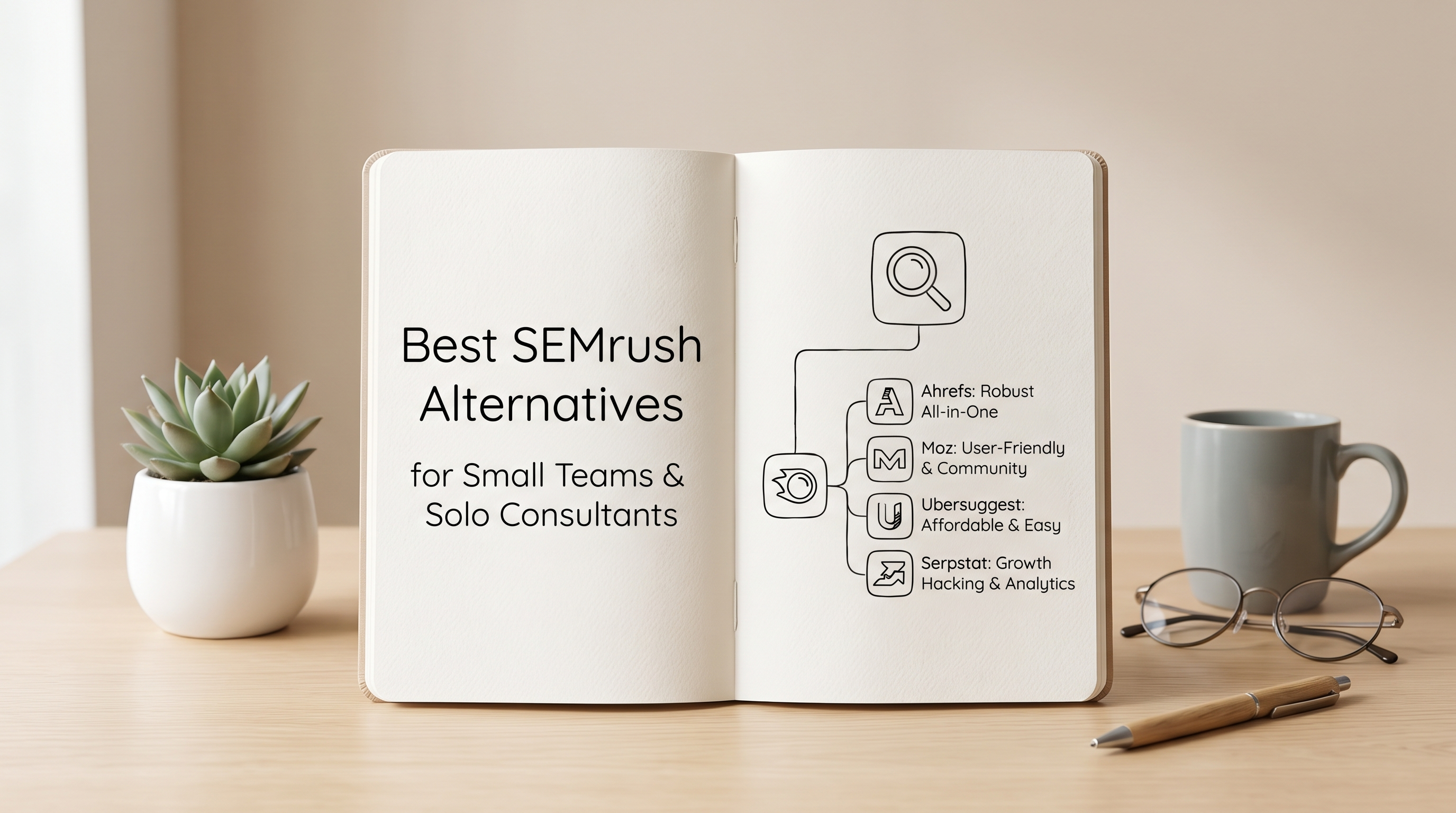
Best SEMrush Alternatives for Small Teams and Solo Consultants
Semrush is a capable platform, but its entry price of $139.95/month plus AI visibility tracking sold as a separate add-on make it a heavy commitment for a two-person agency or a solo consultant billing a handful of clients. Paying enterprise-tier pricing to use 20% of the feature set means you're subsidizing tooling you don't need.
This guide breaks down the best SEMrush alternatives for small teams in 2026, evaluated on the metrics that matter when you're running lean: monthly cost, per-seat economics, data freshness, API access, and whether AI/LLM visibility comes bundled or bolted on.
What Small Teams Actually Need From an SEO Tool
Before comparing products, define the requirements. Enterprise buyers optimize for coverage. Small teams optimize for cost-per-outcome. The practical checklist looks like this:
- Predictable pricing — no surprise overages on keyword tracking or crawl budget.
- Multi-project support — consultants juggle several client domains, so per-project limits matter more than raw feature count.
- Reasonable seat pricing — many tools charge $45–$100 per additional user, which quietly doubles your bill.
- Exportable data — CSV and API access so you can build your own reports instead of paying for polished dashboards you'll rebrand anyway.
- AI/LLM visibility — with search traffic increasingly routed through ChatGPT, Perplexity, and Google AI Overviews, tracking how you appear in generative answers is no longer optional.
With that framing, here are the alternatives worth your attention.
1. Ahrefs — Best for Backlink-Driven Consultants
Ahrefs remains the gold standard for backlink data, and its crawler trails only Google in link discovery volume. For consultants whose value proposition is link building or technical audits, the depth is hard to beat.
Where it fits
- Starter/lite plans now start well below Semrush's tier, with pay-as-you-go credits for occasional users.
- Site Explorer and Content Explorer are best-in-class for competitive research.
- Rank Tracker handles multi-location and mobile/desktop segmentation cleanly.
Watch out for
Ahrefs historically used a credit-based model that penalized heavy report generation. Read the current limits carefully—if you run frequent bulk exports, the credits deplete fast. Seat pricing also runs high for larger teams.
2. Mangools — Best Budget Pick for Solo Consultants
If Semrush is a Swiss Army knife with a chainsaw attachment, Mangools is the clean pocket knife. Its suite (KWFinder, SERPWatcher, SERPChecker, LinkMiner, SiteProfiler) covers roughly 80% of what a solo operator needs at a fraction of the cost.
Why it works for solos
- Entry pricing is dramatically lower than Semrush—often under $50/month billed annually.
- The UI is genuinely approachable, which matters when you hand dashboards to non-technical clients.
- Keyword difficulty scoring is transparent and fast.
Trade-offs
You won't get Ahrefs's crawl depth or Semrush's sprawling toolset. Historical data windows are shorter, and there's no deep site-audit crawler. For a consultant managing 3–8 small sites, that's usually fine.
3. SE Ranking — Best All-Rounder for Small Agencies
SE Ranking hits the sweet spot for teams that want Semrush-style breadth without Semrush pricing. It bundles rank tracking, keyword research, competitive analysis, a site audit crawler, and—critically—white-label reporting.
Standout features
- White-label and client dashboards included on mid-tier plans, so you can resell reporting under your own brand.
- Flexible pricing that scales with tracked keyword volume rather than locking you into rigid tiers.
- An increasingly solid AI visibility module that tracks presence in AI Overviews and generative answers—bundled rather than sold as a premium add-on.
Consideration
Backlink data volume trails Ahrefs. If links are your core service, treat SE Ranking as your primary suite and add a dedicated link tool.
4. Serpstat — Best for Data-Heavy Workflows on a Budget
Serpstat offers an aggressive feature-to-price ratio and a well-documented API, which appeals to technically minded consultants who prefer piping data into their own tooling.
Technical strengths
- API access on relatively affordable plans, enabling automated reporting pipelines.
- Rank tracking, keyword clustering, and site audit in one platform.
- Team plans with sane per-seat costs.
Limitations
Database coverage is strongest in emerging and European markets; US SERP data is good but not the deepest available. The interface feels denser than Mangools or SE Ranking.
5. Ubersuggest — Best for Occasional and Content-First Users
Ubersuggest, from Neil Patel, targets users who need keyword ideas and basic tracking without a subscription treadmill. Its one-time lifetime pricing option is unusual and appealing for consultants who dip in and out.
Good for
- Content marketers who mainly need keyword volume, difficulty, and content ideas.
- Anyone allergic to recurring subscriptions.
Not good for
Deep technical audits, large-scale rank tracking, or enterprise-grade backlink analysis. Treat it as a supplementary tool rather than a full Semrush replacement.
6. Dedicated AI Visibility Tools — The New Category
Here's the strategic shift for 2026: because Semrush charges for AI visibility as an add-on, and because generative search is eating into classic organic clicks, a new category of tools focuses purely on how brands appear in LLM answers.
These tools track:
- Whether your brand is cited in ChatGPT, Claude, Perplexity, and Gemini responses.
- Share of voice against competitors in AI-generated answers.
- Which source pages the models are pulling from.
For a consultant who wants to differentiate on "AI SEO" or "GEO" (generative engine optimization), pairing an affordable core suite like SE Ranking or Mangools with a dedicated AI visibility tracker often costs less than Semrush plus its add-on—and delivers deeper generative-search data.
Side-by-Side: Picking by Use Case
Rather than crown a single winner, match the tool to your workflow.
The solo consultant with 3–6 clients
Mangools or SE Ranking. You need affordable multi-project support and clean client-facing reports. SE Ranking wins if you want white-label dashboards; Mangools wins on pure simplicity and price.
The link-building specialist
Ahrefs. No alternative matches its backlink index. Accept the higher price as a cost of doing your core business.
The technical/automation-minded team
Serpstat. The API and data export flexibility let you build custom pipelines instead of paying for someone else's dashboard aesthetic.
The content marketer on a shoestring
Ubersuggest. Lifetime pricing removes recurring overhead for keyword and content ideation.
The forward-looking agency positioning on AI search
Core suite + dedicated AI visibility tool. This stack future-proofs your service offering and avoids Semrush's add-on tax.
Migration and Practical Tips
Switching tools has hidden costs. Keep these in mind:
- Export your historical data first. Rank tracking history rarely transfers between platforms. Pull CSVs before you cancel.
- Recreate projects during an overlap month. Run both tools in parallel for 30 days to reconcile keyword volume and difficulty discrepancies—vendors calculate these differently.
- Rebuild client reports as templates. If you're moving to a white-label tool, budget an afternoon to design reusable report templates.
- Verify API rate limits if you automate. What looks generous on paper can throttle a nightly reporting job.
The Bottom Line
Semrush earns its reputation, but its pricing assumes you need everything—and most small teams don't. The best SEMrush alternatives for small teams win by matching a specific workflow rather than trying to out-feature the incumbent.
- Choose Mangools or SE Ranking for affordable, client-friendly all-round work.
- Choose Ahrefs if backlinks are your product.
- Choose Serpstat for API-driven, technical setups.
- Choose Ubersuggest for lightweight, occasional use.
- Add a dedicated AI visibility tool to future-proof against the shift toward generative search—without paying Semrush's separate add-on fee.
Start with a free trial of two candidates, run them against the same client domain for a month, and let the data—not the marketing—decide. For a solo consultant or small team, the right stack often costs less than half of Semrush's entry plan while delivering everything you actually bill for.