
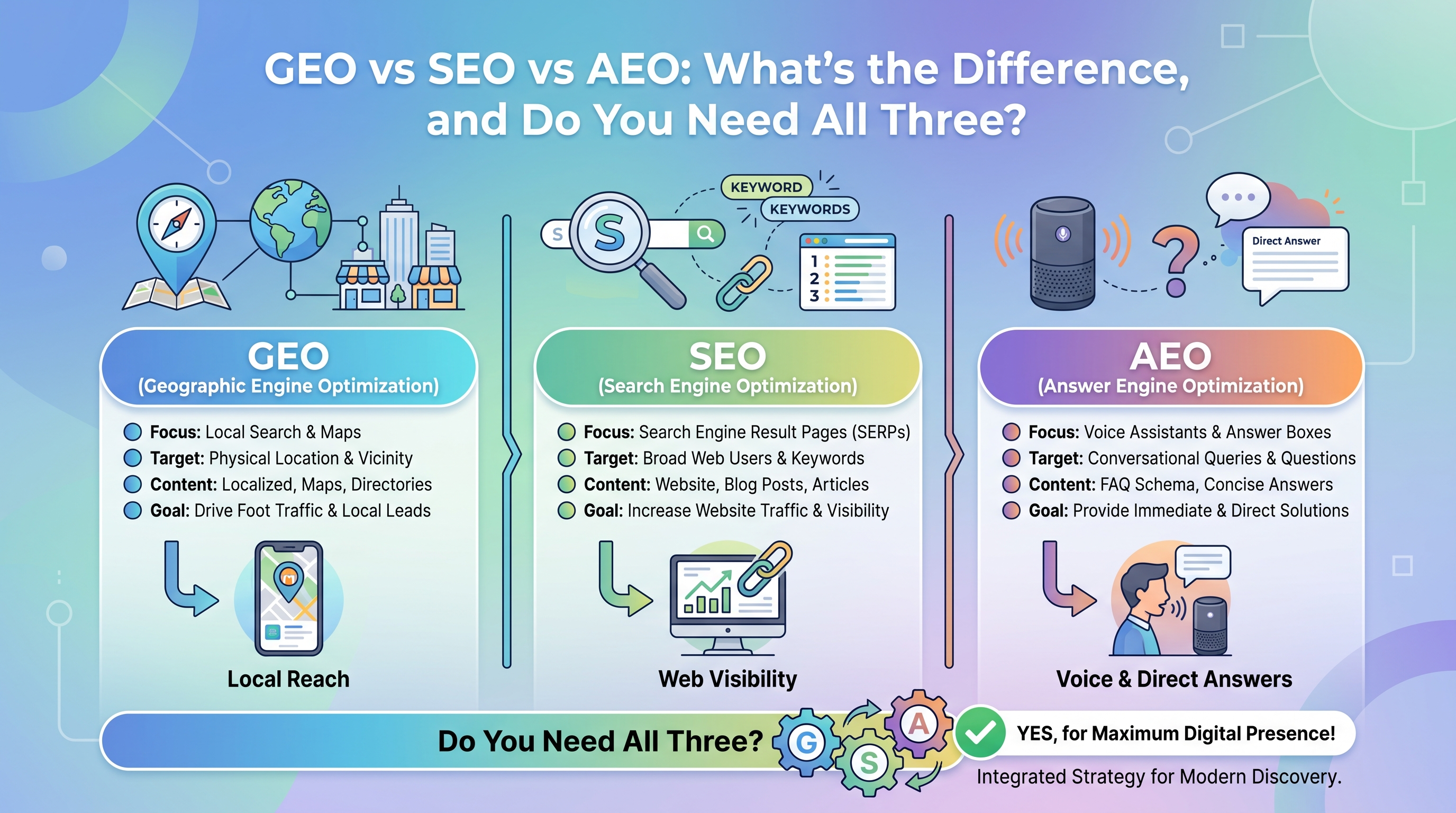
GEO vs SEO vs AEO: What's the Difference, and Do You Need All Three?
A few years ago, the acronym soup of digital visibility was simpler. You did SEO, you ranked in Google, and traffic followed. Now that same conversation includes two newer terms—GEO and AEO—along with a lot of confusion about whether they're distinct disciplines, marketing hype, or just SEO under a new name.
The short answer: GEO vs SEO vs AEO describes three overlapping approaches to the same goal—being found. They aren't rival camps. They're layers that increasingly stack on top of one another as search evolves. This article covers what each one means, where they actually differ, and how to decide which deserve your attention right now.
The Quick Definitions
Before we compare them, let's set clear working definitions.
SEO: Search Engine Optimization
SEO is the practice of improving your website so it ranks higher in traditional search engine results pages (SERPs). It's the oldest and most established of the three, built around keywords, backlinks, technical performance, and content quality. When you optimize a page to appear in Google's blue links, you're doing SEO.
AEO: Answer Engine Optimization
AEO focuses on getting your content picked as a direct answer—what you see in featured snippets, voice assistant replies, and "People Also Ask" boxes. Rather than driving a click to your site, AEO aims to have your content spoken by Alexa or displayed as the definitive answer above the organic results. It's about being the answer, not just an option.
GEO: Generative Engine Optimization
GEO, or generative engine optimization, is the newest term. It targets AI-powered generative tools—ChatGPT, Google's AI Overviews, Perplexity, Claude, and similar systems that synthesize responses from multiple sources. GEO is the craft of making your content likely to be cited, referenced, or paraphrased when an AI model generates an answer for a user.
Where They Overlap
Here's what most breathless "SEO is dead" articles miss: these disciplines share a common foundation. All three depend on:
- High-quality, authoritative content that genuinely answers a question
- Clear structure that machines can parse and understand
- Technical health, including crawlability, fast load times, and clean markup
- Topical authority and trustworthy signals about who you are
If you produce clear, credible, well-structured content, you're feeding all three engines at once. That's why the difference between SEO and GEO is often more about emphasis than about fundamentally different techniques. A page optimized for humans and traditional search is already a strong candidate for AI citation and answer selection.
Where They Genuinely Differ
The overlap is real, but so are the distinctions. Understanding them helps you spend your effort wisely.
The Goal of the Interaction
- SEO wants a click. Success is measured by rankings and organic traffic to your site.
- AEO often accepts a zero-click outcome. Success is being the answer, even if the user never visits you—though brand exposure and voice-search presence still carry value.
- GEO wants a mention. Success is being cited or paraphrased inside an AI-generated response, ideally with attribution that sends referral traffic or builds authority.
The Format That Wins
Each engine rewards a slightly different shape of content.
- Traditional SEO rewards comprehensive pages, strong internal linking, and keyword relevance.
- AEO rewards concise, direct answers—often a single well-phrased paragraph or a tidy list that a snippet algorithm can lift cleanly.
- GEO rewards content that is quotable, statistically rich, and clearly sourced. Generative models tend to favor material with citations, data points, and unambiguous claims they can safely synthesize.
How Success Is Measured
Measurement diverges sharply. SEO has mature analytics: rankings, impressions, clicks, and conversions. AEO is harder—you track featured snippet ownership and voice presence, but attribution is fuzzy. GEO is the murkiest. There's still no standardized way to know how often an AI tool references your brand, though tools that monitor AI answer citations are emerging fast.
A Side-by-Side Comparison
To make the GEO vs SEO vs AEO distinction concrete, take a single user question: "What's the best way to store fresh coffee beans?"
- SEO outcome: Your detailed guide ranks #2 in Google, and the user clicks through to read it.
- AEO outcome: Google pulls a two-sentence summary from your page into a featured snippet, and a smart speaker reads it aloud when someone asks.
- GEO outcome: When someone asks ChatGPT or an AI Overview the same question, the model synthesizes an answer and cites your site as a source, or mirrors your recommended method.
One piece of well-crafted content can hit all three. That's the strategic takeaway.
Do You Actually Need All Three?
This is where nuance matters. You don't need three separate teams, budgets, or content strategies. You need one strong content foundation and an awareness of how each engine consumes it. Here's how to think about priority.
Start With SEO
SEO remains non-negotiable. It's the mature discipline with the clearest ROI, and its best practices—quality content, technical health, authority—directly enable the other two. If your site can't be crawled or your content is thin, no amount of GEO ambition will save you. Traditional search still drives most discovery for most sites.
If your resources are limited, spend them here first.
Layer in AEO for Question-Heavy Niches
Answer engine optimization pays off most when your audience asks direct, factual questions. Think how-to content, definitions, comparisons, local queries, and anything voice-search friendly. If you run a recipe site, a local service business, or a knowledge-based brand, structuring content for snippets and direct answers is a high-value, low-effort addition.
Practical AEO moves include:
- Answering the core question in the first 40–60 words of a section
- Using clear question-based headings (like this article does)
- Adding structured data such as FAQ and How-To schema
- Formatting steps and comparisons as lists and tables
Adopt GEO as AI Search Grows
Generative engine optimization is the fastest-rising priority. As AI Overviews expand and users increasingly ask chatbots instead of typing keywords, being referenced by these systems is becoming a real traffic and authority channel. GEO deserves attention now if you work in a competitive, information-driven space.
Effective GEO tactics include:
- Including original data, statistics, and clearly attributed sources
- Writing in a clear, factual, quotable style that models can safely paraphrase
- Establishing strong entity signals—consistent naming, author bios, and expertise cues
- Earning mentions across authoritative third-party sites, since models weigh corroboration
How to Build One Strategy That Serves All Three
Rather than juggling three checklists, fold the strongest practices into a single workflow. Here's a practical model.
1. Build on Genuine Expertise
All three engines increasingly reward demonstrable expertise and trustworthiness. Publish content written or reviewed by people who actually know the subject, and make that credibility visible. This satisfies Google's quality standards, improves answer selection, and raises the odds an AI model treats you as a reliable source.
2. Structure for Machines and Humans
Use a logical heading hierarchy, short paragraphs, descriptive subheadings, and lists where they fit. Lead each section with a direct answer, then expand. This one habit boosts readability (SEO), snippet eligibility (AEO), and AI parseability (GEO) at once.
3. Add Depth and Data
Original research, concrete numbers, and cited sources make content more authoritative and more quotable. Generative models gravitate toward specific, verifiable claims. Vague, fluffy content is the enemy of all three disciplines.
4. Keep Technical Foundations Solid
Fast load times, mobile friendliness, clean HTML, and proper schema markup underpin everything. If bots struggle to crawl and interpret your pages, you lose visibility across every engine at once.
5. Monitor and Adapt
Track traditional rankings and traffic, watch for featured snippet ownership, and start monitoring whether AI tools cite your brand. Measurement for GEO and AEO is still immature, but establishing a baseline now lets you adapt as the tooling matures.
The Bottom Line
Framing GEO vs SEO vs AEO as a competition is misleading. They're complementary layers of a single discipline: helping the right people find your content, whether through a blue link, a spoken answer, or an AI-generated summary.
Here's the practical priority for most sites:
- SEO is your foundation—do it well and everything else gets easier.
- AEO is a smart layer if your audience asks direct questions.
- GEO is the rising frontier to prepare for as AI search becomes mainstream.
The good news is that the gap between SEO and GEO—and AEO—is smaller than the acronyms suggest. Great, well-structured, authoritative content serves all three at once. Invest in that, understand where each engine places its emphasis, and you won't need to choose between them. You'll be building a site that's ready for however people choose to search next.