
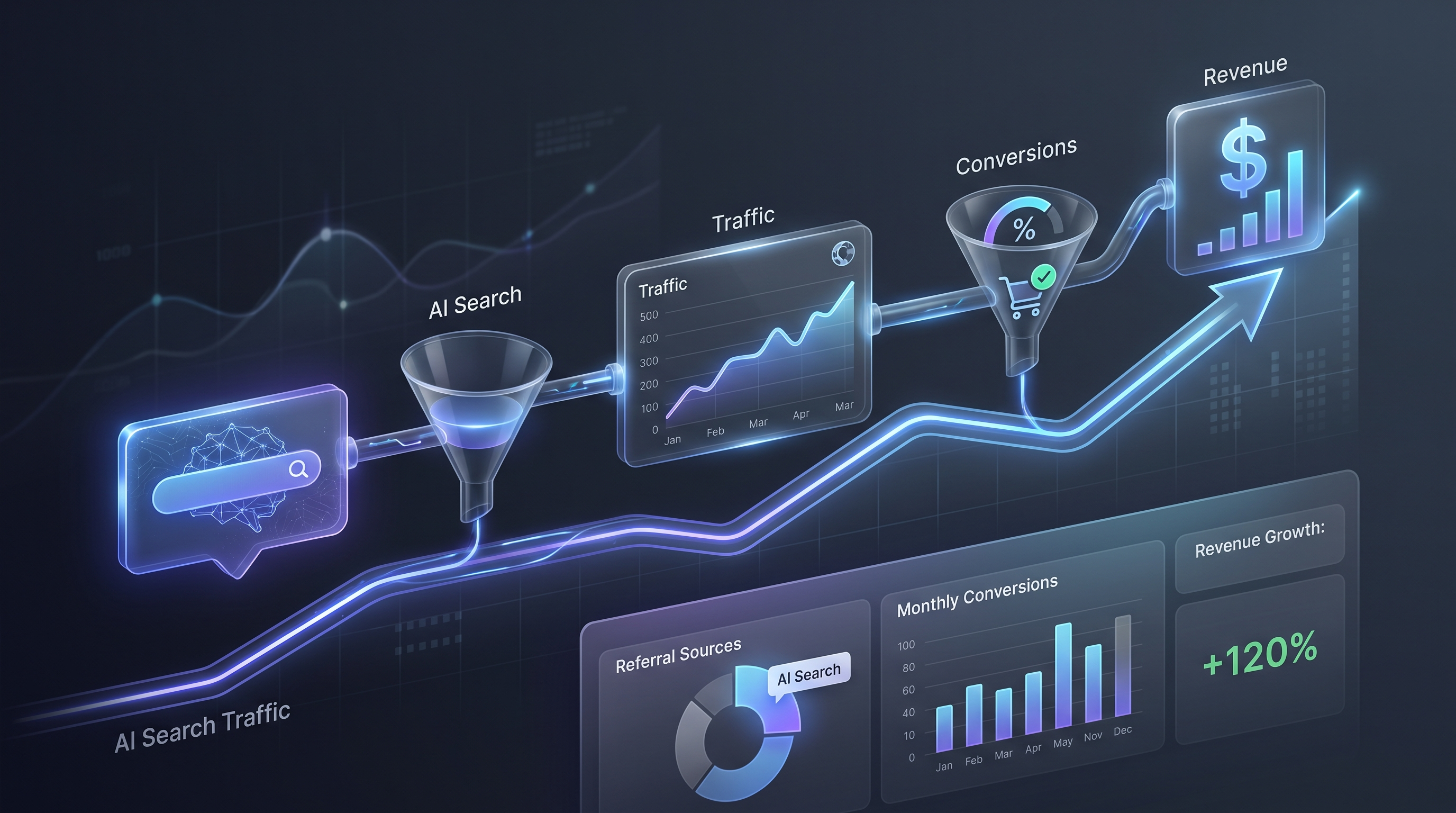
How to Prove AI Search Drives Real Traffic, Not Just Buzz
Every marketing meeting now has its AI moment. Someone mentions ChatGPT, Perplexity, or Google's AI Overviews, and heads nod. Then the talk turns to budget and the mood shifts. Leadership wants proof, not predictions.
Here's the good news: AI search is measurable. You can tie AI referral traffic to actual conversions and build a defensible case for continued investment. This guide shows you how to get from buzz to business impact.
Why AI Search Feels Invisible (But Isn't)
Attribution is the main reason marketers struggle to justify AI search spend. Traditional dashboards weren't built for a world where an assistant summarizes your content and the user clicks through days later.
A few things make AI traffic hard to see:
- Dark referrals: Some AI platforms strip referrer data, so visits show up as "direct."
- Delayed action: Users research with AI, then convert later through branded search.
- Fragmented sources: Traffic arrives separately from ChatGPT, Gemini, Perplexity, Copilot, and AI Overviews.
Invisible isn't the same as absent. Set things up correctly and these visits become trackable, and better yet, tied to revenue.
Step 1: Isolate AI Referral Traffic in GA4
Start by making AI sources visible. Solid GA4 tracking underpins every argument you'll make to leadership.
Build an AI source segment
Create a custom segment or exploration that captures known AI referrers. Common domains to filter for include:
- chatgpt.com and chat.openai.com
- perplexity.ai
- gemini.google.com
- copilot.microsoft.com
- you.com
In GA4, open Explore, build a free-form report, and add a filter on Session source containing these domains. Now you have a clean view of visits arriving from AI tools specifically.
Tag your outbound links and content
Wherever you can shape the link, whether newsletters, syndication, or partner placements AI references, add UTM parameters. Consistent tagging keeps AI-driven sessions from vanishing into your direct bucket.
Step 2: Connect Traffic to Conversions
Traffic alone won't win a budget debate. Conversions will. This is where you prove AI search ROI.
Map AI sessions to key events
In GA4, layer your AI segment over conversion events such as:
- Demo requests or form fills
- Newsletter signups
- Trial starts
- Purchases or checkout completions
Compare the conversion rate of AI referral traffic against your other channels. AI visitors often convert at a higher rate because they arrive with clear intent. The assistant already answered their preliminary questions.
Track assisted conversions
Don't judge AI search by last-click alone. Use GA4's attribution and path exploration reports to see where AI shows up in the customer journey. A user who finds you through Perplexity, then converts via branded search two days later, still owes that conversion to AI visibility.
Step 3: Quantify the Value
Numbers persuade. Translate your findings into language your CFO respects.
Calculate revenue per AI session
Divide the revenue attributed to AI referral traffic by the number of AI sessions. Compare that to your paid and organic averages. A strong per-session value makes a compelling headline for any budget deck.
Estimate cost efficiency
AI search visibility often costs a fraction of paid acquisition. If your AI-driven conversions cost less per acquisition than paid channels, you have a direct efficiency argument:
- Total spend on AI content optimization
- Divided by AI-attributed conversions
- Compared against your blended CAC
When AI beats your average cost per acquisition, the investment defends itself.
Step 4: Show the Trend, Not Just the Snapshot
One month of data is easy to dismiss. A trend line isn't.
Pull three to six months of AI referral traffic and conversion data. Plot the trajectory. If AI sessions and AI-attributed revenue climb while your investment stays flat, you've shown compounding returns, which is exactly what leadership wants to fund.
Add context by tracking your visibility inside AI answers. Tools that monitor whether ChatGPT cites your brand or AI Overviews includes it help you correlate presence with traffic gains.
Step 5: Build the Executive Narrative
Data without a story rarely moves budgets. Package your findings into a tight narrative:
- The behavior shift: More buyers now start research with AI assistants.
- The proof: Isolated AI referral traffic in GA4 shows measurable, growing volume.
- The impact: These sessions convert. Here's the revenue and the ROI.
- The ask: Continued or increased investment to capture a growing channel before competitors do.
Frame AI search the way you'd frame early SEO: whoever invests before it's obvious wins the largest share.
Common Pitfalls to Avoid
Even a solid measurement plan can stumble. Watch for these mistakes:
- Ignoring dark traffic: Investigate spikes in direct traffic that line up with AI tools citing your content.
- Over-relying on last-click: AI often plays an early, assisting role. Credit it accordingly.
- Vanity metrics: Impressions in AI answers matter, but always tie them back to conversions.
- Inconsistent tagging: Sloppy UTMs corrupt your entire AI referral picture.
The Bottom Line
AI search isn't just buzz. It's a maturing acquisition channel you can measure with the same rigor as any other. Isolate AI referral traffic, configure precise GA4 tracking, and connect sessions to conversions, and you turn a trendy talking point into a documented AI search ROI case.
The marketing leads who win budget next year won't be the ones who talk about AI the loudest. They'll be the ones who walk in with a dashboard, a trend line, and a revenue number that ends the debate.
Start measuring now. When the next budget review comes, you'll have proof instead of promises.