
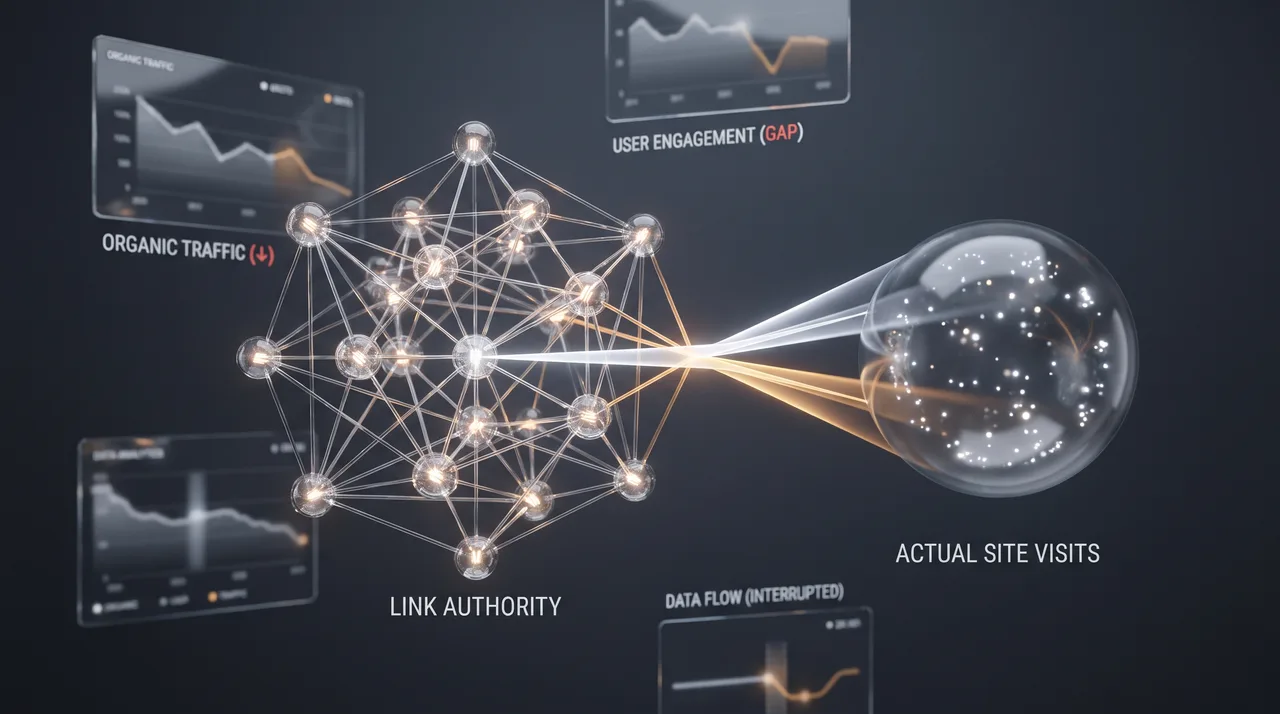
Because AI search answers queries directly, strong rankings and authority no longer guarantee clicks. Your backlink profile still signals authority and helps you get cited in AI answers, but the last step — turning that authority into real visits — keeps breaking down thanks to zero-click summaries, inconsistent citations, and scattered search behavior.
For most of SEO's history, the logic was clean and dependable: build a strong backlink profile, earn higher rankings, collect more clicks. Links stood in for authority, authority drove position, and position drove traffic. You could look at a domain's link graph and make a defensible forecast about the visits it would receive.
That forecast is now unreliable. Over the past two years, the tie between what your backlink profile says about a site and what traffic that site actually gets has loosened dramatically. If you still sell link building on the promise of predictable visits, you're quoting from a model that no longer describes the market.
The chain that used to hold
The old equation had three well-understood links in it.
- Backlinks signal authority. PageRank and its descendants treated a link as a vote. More votes from trustworthy pages meant more trust.
- Authority produces rankings. Google ordered ten blue links largely by relevance and authority, and a strong backlink profile reliably pushed a page up that list.
- Rankings produce traffic. Position one took roughly a third of clicks, position two far less, and everything below the fold was a rounding error.
Each link in that chain was measurable, and the correlations were strong enough that forecasting traffic from authority metrics counted as legitimate agency work. You could promise a client that a certain number of quality links would move a term from page two to the top three, and that the move would be worth a knowable number of sessions.
The problem isn't that any single link in the chain snapped. It's that the final one — rankings producing traffic — has been quietly rewired by AI-driven search.
What AI search changed
When a user asks Google's AI Overviews, ChatGPT, Perplexity, or Gemini a question, the answer gets built and delivered on the spot. The user often gets what they need without visiting a single website. The ranking still happens somewhere inside the system, but the click that used to follow it often doesn't.
This breaks the third link. A page can rank, be cited, even be the main source an AI model draws from — and still get no visit. Your backlink profile may have done its job perfectly at the authority and ranking stages, yet the traffic payoff evaporates when the answer is delivered.
The result is a growing gap between two numbers agencies have long treated as the same:
- The authority your backlink profile commands.
- The sessions that authority actually turns into.
Zero-click is the new baseline
Zero-click behavior existed before AI — featured snippets and knowledge panels started the trend years ago. AI search made it the default. Informational queries, once the bread and butter of top-of-funnel content strategies, are now the ones most likely to be answered without a click.
That matters because informational content was also where link building delivered its clearest wins. A well-linked guide ranking for a broad question used to be a traffic engine. Today that same guide may be feeding an AI summary while its own session count flatlines.
Your backlink profile still matters — just not for what you think
Here's the nuance the doom-posting misses. A strong backlink profile hasn't become worthless. It has changed jobs.
Links still establish authority, and AI systems clearly favor authoritative, well-cited sources when deciding what to synthesize and whom to credit. A site with a credible backlink profile is more likely to be pulled into an answer, more likely to be named as a citation, and more likely to be trusted by the models doing the summarizing.
What the backlink profile no longer does is guarantee the visit afterward. It buys you a seat at the table where the answer gets assembled. Whether that seat becomes a click depends on factors that have nothing to do with your link graph: how the model formats its response, whether it cites sources, whether the user is curious enough to click through, and whether your brand is memorable enough to be sought out directly.
| Role of the backlink profile | Before AI search | After AI search |
|---|---|---|
| Signal authority to search engines | Strong | Still strong |
| Influence rankings | Strong | Strong |
| Get cited in AI answers | N/A | Increasingly important |
| Predict actual traffic | Reliable | Weak and weakening |
| Justify link-building ROI | Easy | Requires new metrics |
Why the gap is widening, not stabilizing
It would be handy if this were a one-time reset we could re-baseline against. It isn't. Several forces are actively pulling authority and traffic further apart.
AI answers are getting better
As models improve, they answer more of the query themselves and leave less reason to click. Every improvement in summary quality is, from a traffic standpoint, a subtraction. The more trustworthy the synthesis, the fewer users feel the need to verify by visiting the source.
Citations are inconsistent
Different AI surfaces cite differently. Some name sources prominently, some bury them, some paraphrase without any attribution. Even when your authoritative content shapes an answer, there may be no visible link for a user to follow. Your backlink profile earned you the influence; the interface quietly declined to pass it on.
Search behavior is fragmenting
Users now spread their questions across Google, ChatGPT, Perplexity, voice assistants, and in-app AI features. Each surface has its own traffic economics. A backlink profile built to win Google rankings tells you very little about how you perform inside a chatbot that never surfaces traditional SERP positions at all.
The AI traffic you can still capture
AI traffic isn't a myth — it's just distributed differently. The visits that do come through AI surfaces tend to be higher intent. A user who clicks a citation after reading a summary has usually been pre-qualified already; they want depth, proof, pricing, or a specific tool the summary couldn't provide.
This reshapes which content earns the remaining clicks:
- Content that resists summarization. Interactive tools, calculators, original data, and proprietary research can't be fully compressed into an answer, so users still have to visit.
- Transactional and decision-stage pages. AI happily answers "what is X" but sends users onward when they're ready to buy, compare, or sign up.
- Brand-anchored content. When your name appears in an answer and the user already trusts you, the click-through rate on that citation rises.
The strategic takeaway is that AI traffic rewards depth and distinctiveness far more than broad informational coverage. The thin, well-linked explainer is the biggest loser in this shift.
Rethinking link building value for clients
None of this means you stop building links. It means you change how you describe and measure the link building value you deliver.
Stop forecasting traffic from authority alone
Promising sessions based on projected authority gains is now a credibility risk. If a client's content sits in a category heavily cannibalized by AI answers, authority gains may not convert, and you'll own the gap. Frame link building as an authority and visibility investment, and forecast traffic separately using real behavior data for the specific query space.
Measure citations and inclusion, not just rankings
Start tracking whether and how your clients show up inside AI answers. Are they cited in AI Overviews? Does Perplexity name them? Does ChatGPT surface their brand when asked relevant questions? These are the new positions a strong backlink profile helps you win, and they're the leading indicators of AI traffic.
Tie links to pages that still earn clicks
Point your link-building effort at the asset types that survive summarization — tools, data, and decision-stage content — rather than broad informational pieces that AI will happily absorb and leave visitless. The link building value is highest where the downstream click is still defensible.
Reframe the pitch
Clients still intuitively get "we make you more authoritative." What they need help seeing is that authority now shows up as inclusion and brand presence across AI surfaces, not just as a number of organic sessions. Agencies that explain this early look like strategic partners. Agencies that keep promising the old traffic math look like they missed the memo.
A practical way to audit the gap
If you want to measure how exposed a client is, run a simple diagnostic.
1. Pull the client's top 50 ranking queries.
2. Classify each as informational, navigational, or transactional.
3. Check which trigger AI Overviews or are commonly answered by chatbots.
4. Flag informational queries with AI answers — these are your at-risk terms.
5. Compare authority metrics vs. actual clicks for those terms over 12 months.
The spread you find between strong authority and declining clicks is the gap this article is about, made concrete for one client. It's also the most persuasive slide you can put in front of someone who still thinks a healthy backlink profile is a traffic guarantee.
The bottom line for agencies
The backlink profile hasn't lost its meaning; it has lost its monopoly on predicting outcomes. Authority still opens doors — it just no longer walks the user through them. The agencies that thrive over the next few years will be the ones that separate authority building from traffic forecasting, measure AI inclusion as seriously as they once measured rankings, and aim their link-building budgets at the content AI can't replace.
Keep building the profile. Just stop treating it as a traffic oracle, and start treating it as what it has become: a credential that earns you a presence in a search landscape where presence and visits are no longer the same thing.