
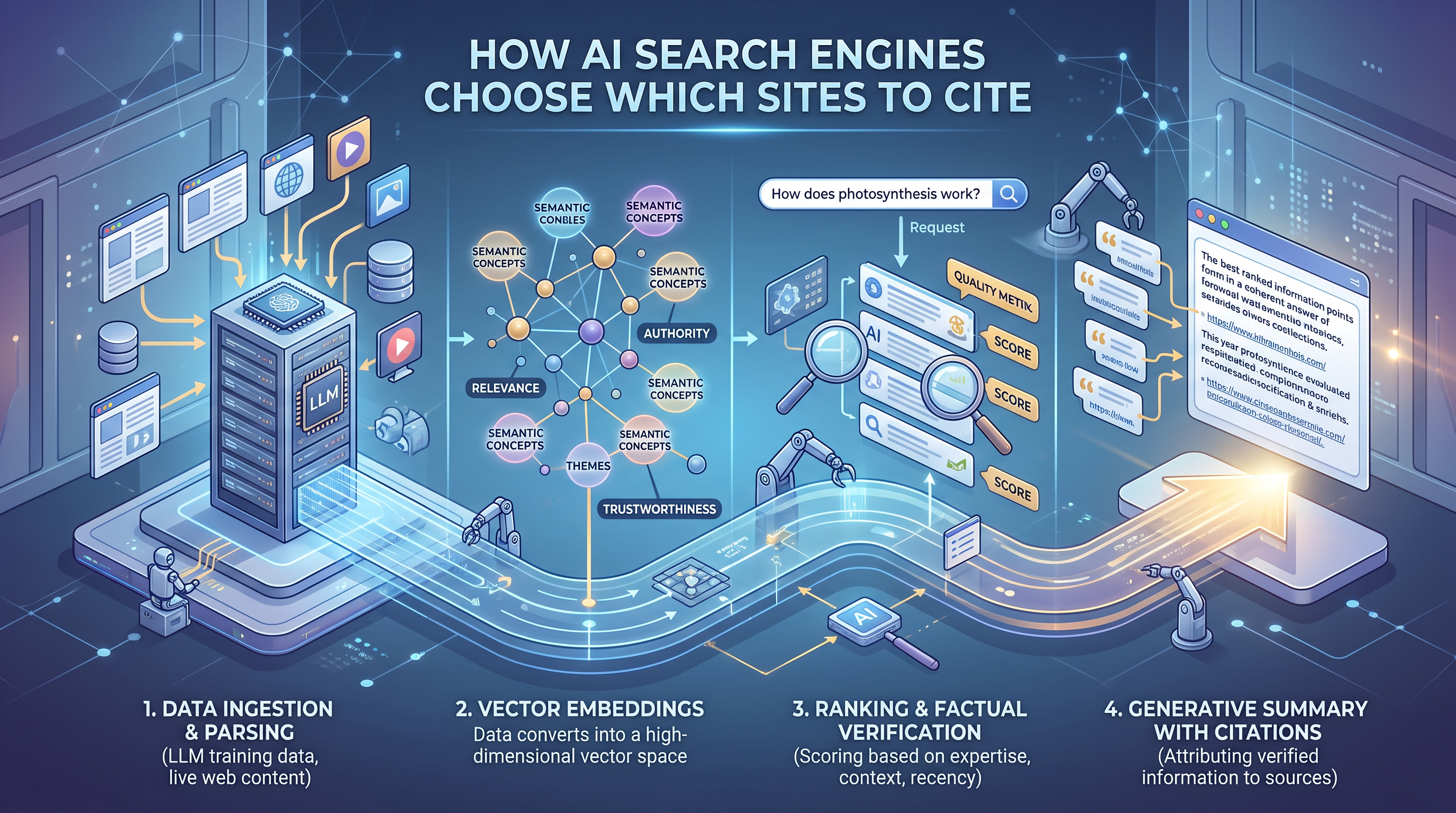
How AI Search Engines Actually Pick Which Sites to Cite
When ChatGPT, Gemini, or Perplexity answers a question and links to a few websites, the choice can seem random. Why those sites and not others? In reality, AI search engines follow a fairly logical process. Knowing how AI search engines choose sources shows you why some pages get cited over and over while others never appear.
This article explains the mechanics behind AI citations, the factors that count most, and what you can do about them.
AI Search Isn't the Same as Traditional Search
Classic search engines hand you a ranked list of ten blue links. You click and read. AI search engines work differently: they read the sources themselves, build an answer, and cite the handful of pages that shaped it.
That shift changes the game. Rather than fighting for a top-ten ranking, your content competes to be quoted inside a generated response. Only a few sources make it into each answer, so the bar is higher and the logic is different.
The Retrieval Step: Query Fan-Out
Before writing an answer, the system has to collect candidate sources. That's where query fan-out comes in.
Ask a complex question and the AI won't run a single search. It splits your prompt into several sub-queries and searches each one on its own. A question like "Which electric SUV has the best range and how much does it cost?" might fan out into:
- "electric SUV longest range 2024"
- "electric SUV price comparison"
- "EV range vs cost analysis"
Each sub-query returns its own set of results. The engine pools these candidates before deciding what to cite.
Why fan-out matters for your site
Since a single answer draws from several sub-queries, your page only has to win one of them to reach the candidate pool. Content that covers a topic thoroughly tends to match more sub-queries, so it gets more chances to be retrieved.
The Ranking Step: AI Citation Factors
Once the candidates are in, the model decides which ones to actually cite. A handful of AI citation factors shape that decision every time.
1. Relevance to the specific claim
What matters most is whether your page directly answers the sub-question at hand. AI systems favor pages where the answer is stated plainly, not buried under filler. When the model needs to make a factual claim, it looks for the source that backs that exact claim.
2. Clarity and structure
Models read content more reliably when it's well organized. Clear headings, short paragraphs, direct definitions, and structured data all make your content easier to pull from. A page that answers "What is X?" in a clean opening sentence is easier to cite than one that wanders.
3. Topical authority and trust signals
AI search engines rely on established trust signals. Sites with a solid reputation, steady expertise in a subject, and recognizable authorship get picked more often. This lines up with traditional E-E-A-T (experience, expertise, authoritativeness, trustworthiness) principles.
4. Freshness
For time-sensitive queries—prices, news, product releases, statistics—recency counts a lot. An up-to-date page usually beats an older one on the same subject, even when the older page has more backlinks.
5. Corroboration across sources
AI systems often prefer information that several sources agree on. If your claim matches what other reputable pages say, it's more likely to be treated as reliable and cited with confidence.
6. Crawlability and accessibility
None of this counts if the engine can't read your page. Content locked behind logins, heavy JavaScript, or aggressive bot restrictions may never reach the candidate pool. Clean, accessible HTML gives you the best shot.
How Does ChatGPT Choose Sources Specifically?
People often ask how does ChatGPT choose sources compared with other tools. When ChatGPT browses or searches, it follows the same broad pattern: fan out the query, retrieve candidates, and cite the pages that best support what it wrote.
A few details stand out:
- It cites what it uses. ChatGPT tends to link the pages it actually pulled text from, not a general list of relevant sites.
- It prefers extractable answers. Pages that state facts plainly are easier for the model to quote and attribute.
- It favors concise authority. A tightly written page that answers the question directly often beats a longer, less focused one.
Gemini and Perplexity work on similar principles, though each weights freshness, authority, and source diversity a little differently. Perplexity, for example, is known for surfacing several citations per answer and rewarding sources that add distinct information.
What This Means for Content Creators
If you want AI search engines to cite you, the takeaways are practical:
- Answer questions directly. Lead with a clear, self-contained answer, then add nuance.
- Cover topics comprehensively. Broad, well-structured coverage matches more fan-out sub-queries.
- Structure for extraction. Use descriptive headings, lists, and clear definitions.
- Keep content current. Update statistics, prices, and dated claims regularly.
- Build genuine authority. Consistent expertise and trust signals still carry weight.
- Stay crawlable. Make sure bots can actually read your pages.
The Bigger Picture
AI citation isn't magic, and it isn't random. It's a retrieval-and-ranking process driven by query fan-out, relevance, clarity, authority, freshness, and accessibility. The sites that get cited are the ones that make it easy for a model to find a trustworthy, well-stated answer.
As AI search keeps growing, the goal moves from ranking well to being the clearest, most reliable source a model can quote. Optimize for that, and the citations will follow.
Frequently Asked Questions
Do backlinks still matter for AI citations?
They feed authority and trust, which affect selection, but direct relevance and clarity often matter more for a specific answer.
Can I force an AI to cite my site?
No. You can only make your content more likely to be retrieved and quoted by improving relevance, structure, freshness, and accessibility.
Is being cited by AI different from ranking on Google?
Yes. Traditional ranking competes for clicks in a list; AI citation competes to be quoted inside a synthesized answer, which rewards direct, extractable content.