
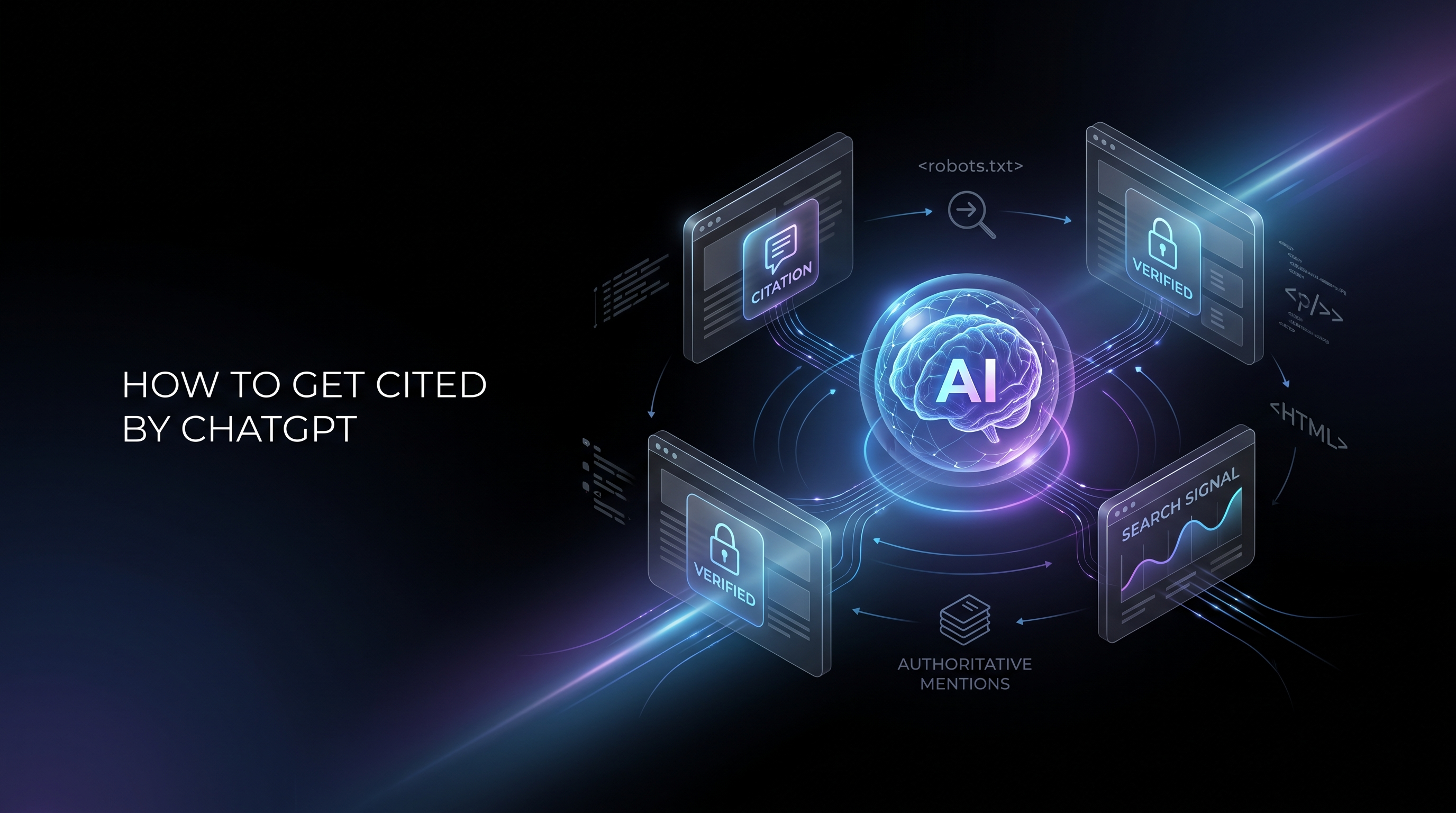
ChatGPT cites pages it can fetch, parse and trust. In practice that means three things: let GPTBot reach the page, state the answer in a plain sentence near the question it answers, and be corroborated somewhere the model already reads. There is no submission form and no placement to buy. Citation follows from being the clearest source.
Can ChatGPT actually reach your page?
This is the first question because it is the one that silently fails. OpenAI crawls the open web with GPTBot, and like any crawler it obeys robots.txt. A single Disallow aimed at GPTBot, or a broad rule that happens to cover the directory your articles live in, removes you from consideration entirely. Nothing about your writing matters after that.
Two things are worth checking directly rather than assuming. First, that your robots.txt does not block GPTBot, OAI-SearchBot or ChatGPT-User, which are three different agents doing three different jobs. Second, that the content is in the HTML the server returns, not assembled afterwards by JavaScript, because a crawler that does not execute scripts sees an empty page where your article should be.
Our free AI visibility checker reads a page the way an answer engine does and scores eleven weighted signals, including whether the crawler is allowed in and whether the body text survives without JavaScript.
What makes a page quotable rather than just readable?
A model composing an answer needs a sentence it can lift without rewriting. Prose that circles a point for three paragraphs before making it is readable to a person and useless to a summariser. The pages that get quoted tend to share a shape:
- The claim sits immediately after the heading that asks the question, not at the end of the section.
- Specifics rather than adjectives: a number, a threshold, a name, a date.
- Headings phrased as the question a person would actually type.
- One idea per paragraph, so a quote can be taken without losing its qualifier.
This is also why an FAQ block earns its place. It pairs a question with a short, complete answer, which is the exact unit an assistant is looking for.
Why do third-party mentions matter more than your own page?
A model weighing which source to name is not only reading you. It is reading what other people wrote about you, and a claim that appears in several independent places reads as established rather than promotional. This is the uncomfortable part of the work, because it is the part you do not control: being written about is not something you can publish your way to.
Forums and community threads carry disproportionate weight here, partly because they are dense with the phrasing real buyers use. If your category is discussed somewhere and your name is absent from that discussion, that absence is doing more damage than any on-page issue.
How do you tell whether it worked?
Not by asking ChatGPT about yourself. A single prompt in a single session is one sample, it is shaped by whatever else is in that conversation, and it tells you nothing about what a stranger would see.
What is worth measuring is how often you are named across a set of real category questions that never mention your brand, tracked over time rather than on the day you happened to check. That is what Metric Vault's AI visibility tools do: send the same prompts to each engine on a schedule, and report how often you appeared, how early, and which domains were cited instead of you.
Expect this to move slowly. You are waiting on a recrawl, and then on your claim being reinforced elsewhere. Weeks, not days.