
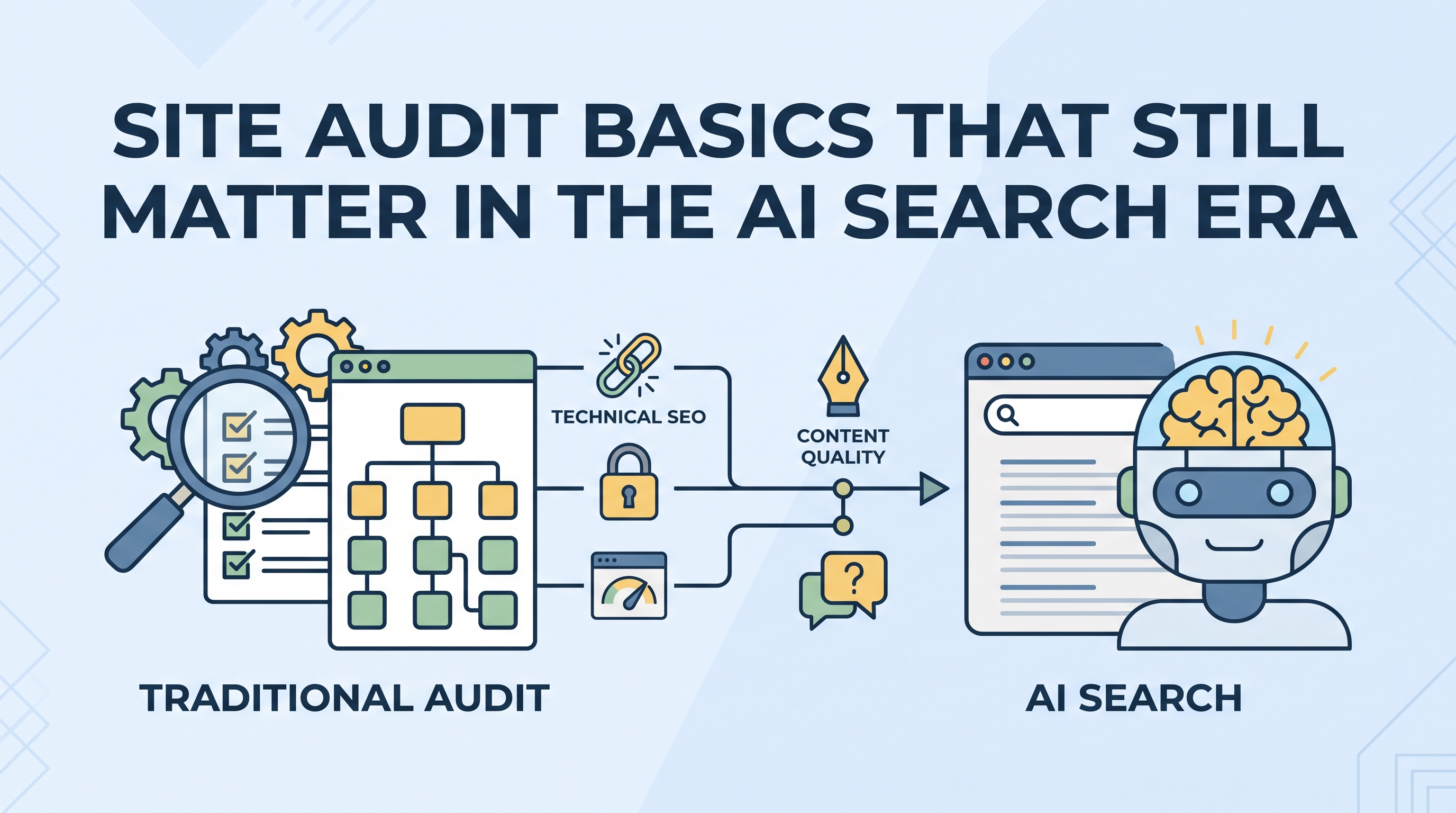
Site Audit Basics That Still Matter in the AI Search Era
Every few years, a new technology convinces marketers that the old rules are obsolete. Generative AI and AI-powered search are the latest arrivals, and it's tempting to believe that clever prompts and content tuned for large language models have replaced the unglamorous work of a technical site audit.
They haven't. If anything, AI search has raised the stakes for getting the fundamentals right. Answer engines, retrieval-augmented generation systems, and AI overviews all depend on the same infrastructure traditional crawlers use: pages that can be discovered, rendered, understood, and trusted. When that infrastructure breaks, your content never enters the pool of sources an AI can cite.
This article is a practical reminder of the site audit basics that still matter—and why each one is now part of your AI search readiness rather than a relic of the pre-AI web.
Why Technical Fundamentals Underpin AI Visibility
Start by understanding how AI search systems actually source information. Most don't invent facts about your business. They retrieve content from an index or a live crawl, rank it for relevance, and synthesize an answer. Google's AI Overviews, Bing's Copilot, and third-party assistants that browse the web all rely on crawling and indexing pipelines that closely resemble classic search infrastructure.
So the chain of dependencies looks like this:
- A bot must be allowed to reach your page.
- The bot must be able to render and parse the content.
- The content must be structured clearly enough to extract meaning.
- The domain must carry enough trust to be worth citing.
Break any link in that chain and your beautifully written, AI-friendly content becomes invisible. A site audit is the systematic process of testing every link. Technical SEO is not the opposite of AI optimization—it is the precondition for it.
Crawlability: If Bots Can't Reach It, AI Can't Cite It
Crawlability is still the first checkpoint of any audit, and AI crawlers have made it more complicated, not less.
Audit your robots.txt and bot access
Start with robots.txt. Confirm you aren't accidentally blocking directories that hold important content. Then decide, deliberately, how to treat AI-specific user agents such as GPTBot, Google-Extended, PerplexityBot, and CCBot. Blocking them may protect your content from training use, but it can also remove you from certain AI answer surfaces. Whatever you choose, make it an intentional decision recorded in your audit—not an accident.
Check crawl budget and orphan pages
Large sites still waste crawl budget on faceted navigation, session parameters, and infinite calendar loops. Use log file analysis or your platform's crawl stats to see where bots spend their time. Find orphan pages—URLs with no internal links pointing to them. If nothing links to a page, both traditional and AI crawlers struggle to find it, and it rarely gets indexed.
Validate your XML sitemap
A clean sitemap that lists only canonical, indexable, 200-status URLs is one of the cheapest wins in a site audit. Remove redirected, noindexed, and 404 URLs. Keep lastmod dates accurate so crawlers know what changed.
Indexing: Making Sure the Right Pages Are Eligible
Crawling gets bots to your pages; indexing determines whether those pages are stored and eligible to appear anywhere—including as AI sources.
Review index coverage
Use Google Search Console's Pages report to see what's indexed and what isn't. Watch categories like "Crawled – currently not indexed" and "Discovered – currently not indexed," which often signal thin content, duplication, or quality issues that also suppress AI eligibility.
Manage canonicalization and duplication
Duplicate content dilutes signals. Confirm that:
- Every page has a self-referencing canonical unless it deliberately points elsewhere.
- HTTP and HTTPS, www and non-www, and trailing-slash variants resolve to one version.
- Parameterized URLs consolidate to their canonical form.
When an AI system decides which URL to cite, ambiguity works against you. A single, authoritative version of each page raises the odds that your preferred URL is the one referenced.
Audit noindex and status codes
Hunt for accidental noindex tags, especially leftovers from staging environments. Then map your status codes: 200 for live pages, 301 for permanent moves, 410 for deliberately removed content, and clean 404s for genuine dead ends. Long redirect chains slow crawlers and should be flattened to a single hop.
Rendering and JavaScript: Content Bots Can Actually See
Many AI crawlers don't execute JavaScript as thoroughly as Googlebot does, if at all. That makes rendering a critical part of a modern site audit.
Test what the raw HTML contains
View the source or use a fetch-and-render tool to compare the rendered DOM with the raw HTML response. If your primary content, headings, and links appear only after client-side JavaScript runs, some AI systems may never see them. Where you can, deliver core content through server-side rendering or static generation so it sits in the initial HTML payload.
Check lazy-loaded and gated content
Content hidden behind tabs, accordions, infinite scroll, or interaction triggers can be missed. Make sure important text is in the markup even if it's visually collapsed, and avoid gating essential information behind actions a crawler won't perform.
Site Structure and Internal Linking
Information architecture helps machines understand relationships between topics—a signal that matters as much to AI synthesis as it does to ranking.
Build logical topic clusters
Group related content into clear hubs and spokes. A well-organized cluster signals topical authority and gives crawlers a coherent map of your expertise. It also helps AI systems associate your brand with specific subject areas.
Keep internal links descriptive
Use descriptive anchor text rather than "click here." Anchor text provides context about the destination page, which aids relevance scoring and semantic understanding. Audit for broken internal links and reduce the click depth of important pages so nothing valuable sits five levels deep.
Structured Data: Speaking the Language of Machines
Schema markup has quietly become one of the most valuable elements of AI search readiness. Structured data translates your content into explicit, machine-readable facts, reducing the chance that an AI misreads what your page is about.
Prioritize high-value schema types
Depending on your content, implement:
- Organization and WebSite schema for brand entity clarity.
- Article or BlogPosting for editorial content.
- Product and Offer for ecommerce.
- FAQPage and HowTo for question-and-answer content.
- BreadcrumbList to reinforce site structure.
Validate every implementation with a schema testing tool and confirm the marked-up data matches the visible content. Mismatched or spammy structured data undermines trust.
Think in terms of entities
AI systems reason about entities—people, places, organizations, products—and the relationships between them. Consistent structured data, paired with clear naming and linking, helps establish your brand as a recognizable entity. This is increasingly how AI decides who is authoritative on a topic.
Core Web Vitals and Page Experience
Performance is more than a ranking factor. It affects whether crawlers can process your pages efficiently and whether users stay long enough to convert.
Audit the vitals
Measure Largest Contentful Paint, Interaction to Next Paint, and Cumulative Layout Shift using field data where available. Slow, heavy pages waste crawl budget and frustrate users. Common fixes an audit surfaces include:
- Compressing and correctly sizing images, using modern formats like WebP or AVIF.
- Deferring non-critical JavaScript.
- Eliminating render-blocking resources.
- Reserving space for images and embeds to prevent layout shift.
A fast site is easier for every kind of bot to crawl at scale, which indirectly supports how frequently and completely your content is refreshed in AI indexes.
Mobile and HTTPS: Non-Negotiable Baselines
Mobile-first indexing means the mobile version of your site is the version that counts. Your audit should confirm that content, structured data, and internal links match across mobile and desktop—not stripped down on mobile.
HTTPS is still a baseline trust signal. Check for valid certificates, no mixed-content warnings, and proper redirects from HTTP to HTTPS. These are table stakes, and their absence can quietly disqualify you from consideration.
Content Quality and E-E-A-T Signals
A site audit isn't purely technical. AI systems weigh signals of experience, expertise, authoritativeness, and trustworthiness when choosing sources to synthesize and cite.
Review the trust layer
During your audit, confirm you have:
- Clear author bios with credentials.
- Visible publication and update dates.
- Accessible contact, about, and policy pages.
- Citations to primary sources where appropriate.
Prune and consolidate
Thin, outdated, or redundant pages drag down perceived quality across the whole domain. Identify low-value URLs and decide whether to improve, consolidate, or remove them. A leaner, higher-quality site sends stronger authority signals to both search and AI systems.
A Practical Site Audit Checklist for the AI Era
Use this condensed checklist as a starting framework:
- Crawlability – robots.txt reviewed, AI bot access decided, crawl budget optimized, no orphan pages.
- Indexing – coverage report clean, canonicals consistent, no accidental noindex, tidy status codes.
- Rendering – core content present in raw HTML, no critical content locked behind JavaScript.
- Structure – logical clusters, descriptive internal links, shallow click depth, no broken links.
- Structured data – priority schema implemented and validated, entity signals consistent.
- Performance – Core Web Vitals within thresholds, images and scripts optimized.
- Baselines – mobile parity confirmed, HTTPS clean with no mixed content.
- Quality and trust – E-E-A-T signals present, thin content pruned.
The Bottom Line
AI search changes how answers are delivered, but it doesn't change the physics of the web. A page still has to be crawled, indexed, rendered, understood, and trusted before any AI surfaces it. The site audit remains the discipline that guarantees each of those steps works, and technical SEO is the foundation on which every advanced tactic is built.
Think of it this way: content optimized for AI is the message, but your technical infrastructure is the delivery system. A brilliant message that never reaches the reader accomplishes nothing. Marketers who keep running rigorous audits—crawlability, indexing, rendering, structure, schema, performance, and trust—will find their AI search readiness takes care of itself. The fundamentals didn't go away. They just became the price of admission to a new stage.