
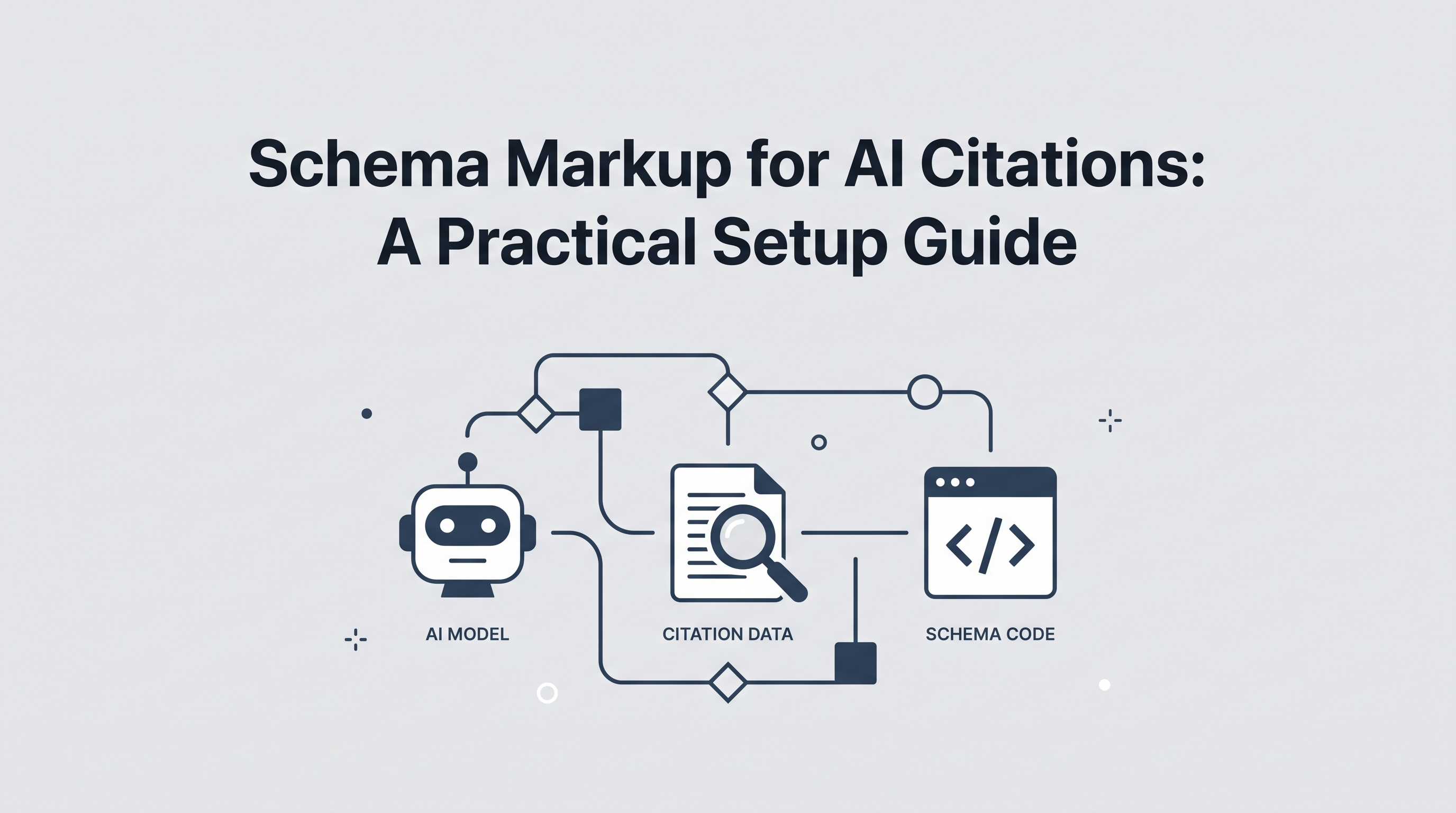
AI-powered search and answer engines are changing how people find content. Instead of clicking through ten blue links, users get synthesized answers, often with citations back to source pages. To make your content one of those cited sources, you need to make it machine-readable. That's the job of schema markup.
This guide covers schema markup for AI citations: which schema types matter most, how to implement them with JSON-LD, and how to verify your work with a schema markup validator.
Why Schema Markup Matters for AI Citations
Large language models and AI search engines read more than your prose. They parse the structured signals around it. Schema markup is a standardized vocabulary from Schema.org that describes what your content is: an article, a recipe, a product, an FAQ, a person, or an organization.
When an AI engine can confidently identify these entities and their relationships, it can:
- Attribute facts to the correct source
- Distinguish the author from the publisher
- Extract answers with higher confidence
- Cite your page as an authoritative reference
Structured data won't guarantee a citation, but it cuts ambiguity sharply. Ambiguity kills attribution. If a model can't tell who said something or what a page is about, it's far less likely to cite it.
The shift from ranking to referencing
Traditional SEO optimized for ranking. AI citations optimize for referencing: being the trusted source an answer draws from. Structured data now pulls double duty. It helps classic search features like rich results, and it helps AI systems ground their responses in verifiable sources.
Understanding JSON-LD: The Preferred Format
There are three ways to add structured data: Microdata, RDFa, and JSON-LD. For nearly every use case today, JSON-LD is the right choice.
JSON-LD (JavaScript Object Notation for Linked Data) lives in a single
Here's the basic structure:
```html
{
"@context": "https://schema.org",
"@type": "Article",
"headline": "Schema Markup for AI Citations",
"author": {
"@type": "Person",
"name": "Jane Doe"
}
}
```
The @context tells parsers you're using the Schema.org vocabulary. The @type declares what kind of thing you're describing. Everything else fills in the details.
The Schema Types That Matter Most
You don't need every schema type. Focus on the ones that carry the most weight for AI citation and match your content.
1. Article / BlogPosting
For editorial content, Article (or the more specific BlogPosting and NewsArticle) is foundational. It gives engines the headline, publish date, author, and publisher.
```json
{
"@context": "https://schema.org",
"@type": "BlogPosting",
"headline": "Schema Markup for AI Citations: A Practical Setup Guide",
"datePublished": "2024-06-01",
"dateModified": "2024-06-10",
"author": {
"@type": "Person",
"name": "Jane Doe",
"url": "https://example.com/authors/jane-doe"
},
"publisher": {
"@type": "Organization",
"name": "Example Media",
"logo": {
"@type": "ImageObject",
"url": "https://example.com/logo.png"
}
}
}
```
The dateModified field matters more than people realize. AI engines favor fresh, maintained content when choosing what to cite.
2. FAQPage
Question-and-answer content maps neatly to how AI engines respond. FAQPage schema packages explicit question and answer pairs that a model can extract and attribute easily.
```json
{
"@context": "https://schema.org",
"@type": "FAQPage",
"mainEntity": [{
"@type": "Question",
"name": "What is schema markup?",
"acceptedAnswer": {
"@type": "Answer",
"text": "Schema markup is structured data that describes the meaning of your content to machines."
}
}]
}
```
Only mark up questions and answers that genuinely appear on the page. Inventing hidden FAQs violates guidelines.
3. HowTo
For step-by-step content, HowTo clarifies the sequence and the goal. This helps AI engines reproduce accurate instructions and credit your page.
4. Organization and Person
Entity schema is the backbone of trust. Organization and Person markup, connected through a consistent @id and sameAs links to authoritative profiles (Wikipedia, LinkedIn, official social accounts), helps AI systems build an accurate picture of who stands behind the content.
```json
{
"@context": "https://schema.org",
"@type": "Organization",
"@id": "https://example.com/#organization",
"name": "Example Media",
"url": "https://example.com",
"sameAs": [
"https://www.linkedin.com/company/example-media",
"https://twitter.com/examplemedia"
]
}
```
The sameAs property is one of the highest-value signals for entity disambiguation.
5. Product and Review
If you publish product information, Product, Offer, and Review/AggregateRating schema let AI engines pull precise specs, prices, and sentiment with confidence.
6. WebSite and BreadcrumbList
WebSite (with SearchAction) and BreadcrumbList help engines understand site structure and navigation context, which reinforces your topical authority.
A Practical Setup Workflow
Here's a repeatable process for adding structured data for SEO and AI citations.
Step 1: Inventory your content types
List the kinds of pages you publish: articles, guides, product pages, author bios, FAQs. Map each to the most specific applicable schema type. Specificity beats generality.
Step 2: Build a base entity graph
Define your Organization and primary Person (author) entities once, each with a stable @id. Reference them from every page instead of redefining them. This creates a coherent knowledge graph across your site.
Step 3: Add page-level markup
For each page, add the primary schema (say, BlogPosting) and link it to your entity graph:
```json
{
"@context": "https://schema.org",
"@type": "BlogPosting",
"headline": "Your Title",
"author": { "@id": "https://example.com/#jane-doe" },
"publisher": { "@id": "https://example.com/#organization" }
}
```
Using @id references keeps your markup DRY and internally consistent.
Step 4: Combine multiple types cleanly
A single page often warrants more than one type, say a BlogPosting that also contains an FAQPage. Use an array under @graph:
```json
{
"@context": "https://schema.org",
"@graph": [
{ "@type": "BlogPosting", "headline": "..." },
{ "@type": "FAQPage", "mainEntity": [] }
]
}
```
Step 5: Match markup to visible content
This is the golden rule. Your structured data must describe content that actually appears on the page. Mismatches erode trust and can trigger penalties.
How to Validate Your Structured Data
Invalid markup is worse than no markup. It wastes crawl attention and can be ignored outright. Always run your output through a schema markup validator before shipping.
Recommended validation tools
- Schema.org Validator (validator.schema.org): A vendor-neutral tool that checks your JSON-LD against the full Schema.org vocabulary. Ideal for catching syntax and property errors.
- Google Rich Results Test: Confirms whether your markup is eligible for Google's rich results and flags Google-specific requirements.
- Structured data linters and CI checks: For larger sites, build validation into your pipeline so broken markup never reaches production.
What to check during validation
- No syntax errors (missing commas, unclosed braces)
- Required properties are present for each type
- URLs are absolute, not relative
- Dates use ISO 8601 format (YYYY-MM-DD)
- Referenced @id values resolve within the graph
Run the validator after every significant template change, not just once.
Common Mistakes to Avoid
Even experienced teams trip on the same issues.
- Marking up invisible content. If it's not on the page, don't put it in the schema.
- Using overly generic types. Prefer BlogPosting over Article, and SoftwareApplication over Thing where applicable.
- Forgetting dateModified. Freshness signals influence citation likelihood.
- Broken entity references. An @id that points nowhere breaks your knowledge graph.
- Duplicate or conflicting markup. Two Article blocks with different headlines confuse parsers.
- Relative URLs. Always use fully qualified absolute URLs for images, authors, and publishers.
Measuring the Impact
Structured data's effect on AI citations is harder to measure than classic rich-result impressions, but several signals are worth watching:
- Rich result performance in Google Search Console's enhancement reports
- Referral traffic from AI assistants and answer engines that pass through links
- Brand mentions in AI-generated answers (test by querying the engines directly with your target questions)
- Crawl and indexing health for pages carrying new markup
Treat these as directional. The broader goal is reducing ambiguity so any capable engine, search or AI, can accurately understand and reference your work.
Putting It All Together
Schema markup for AI citations isn't a niche tactic. It's becoming table stakes for content that wants to be found and referenced in an AI-mediated web. The recipe is simple:
- Choose the most specific schema types for each content type.
- Implement them in JSON-LD, referencing a consistent entity graph.
- Keep markup aligned with visible content and freshness dates current.
- Validate everything with a schema markup validator before publishing.
Do this consistently and you build a durable foundation of structured data for SEO that pays off across traditional search, rich results, and the emerging world of AI-generated answers. Machines can only cite what they understand, so make your content unmistakably clear.
Quick-start checklist
- [ ] Define Organization and author Person entities with stable @ids
- [ ] Add BlogPosting/Article markup to every editorial page
- [ ] Layer in FAQPage or HowTo where content fits
- [ ] Use sameAs links for entity disambiguation
- [ ] Validate with the Schema.org Validator and Rich Results Test
- [ ] Keep dateModified accurate on every update
Start with your highest-value pages, prove the workflow, then roll it out template by template across your site.