
Is Traditional SEO Dead in 2026? What the Data Actually Shows
Every few years, someone declares SEO dead. This time the obituary comes with a compelling story: AI Overviews now sit atop search results, chatbots answer questions directly, and users increasingly get what they need without clicking a single blue link.
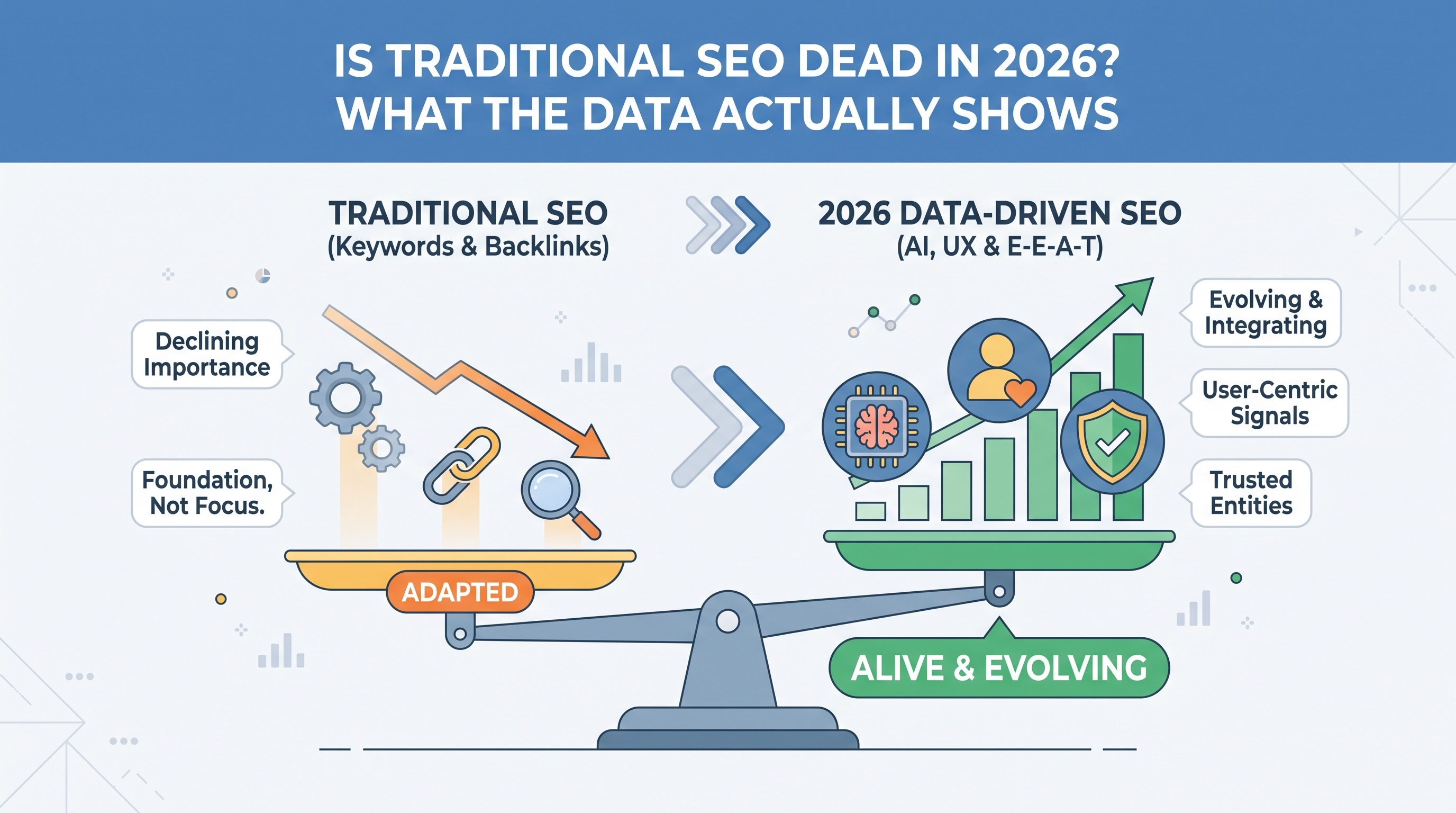
So is it true? Is traditional SEO dead in 2026? The short answer is no. The longer answer is far more interesting. SEO hasn't died. It has been forced to evolve faster than at any point in its history.
Let's look at what the data actually shows.
What Actually Changed
Search in 2026 looks meaningfully different from just three years ago. Three shifts stand out.
AI Overviews became the default, not the exception
When Google began rolling out AI-generated summaries at the top of results, many assumed they'd be a niche feature. Instead, they now appear on a large share of informational queries. These summaries pull from multiple sources, synthesize an answer, and present it before any traditional listing.
The effect is real. For questions like "how do I" or "what is," users often get a satisfactory answer without scrolling.
Conversational search went mainstream
Millions of people now start their research inside ChatGPT, Gemini, Perplexity, or Copilot rather than a search box. These tools don't just answer. They cite sources, follow up, and refine. This is a genuinely new discovery channel that barely existed a few years ago.
Zero-click search accelerated
The rise of zero-click search—queries that end without a click to any website—is the trend that most alarms publishers. When the answer lives right on the results page, the incentive to click drops.
But here's the nuance the headlines miss. Zero-click behavior was already growing long before AI Overviews. Featured snippets, knowledge panels, weather widgets, and calculator results have been absorbing clicks for years. AI simply intensified an existing pattern.
So Does SEO Still Matter?
If you're wondering does SEO still matter in this environment, consider where AI answers come from. AI Overviews and chatbot responses aren't invented from nothing. They're assembled from indexed web content. To be summarized, cited, or recommended by an AI system, your content first has to exist, be discoverable, and be trusted.
That's SEO. The fundamentals of being crawlable, authoritative, and relevant haven't disappeared. They've become the entry ticket to a new layer of visibility.
The data backs this up in several ways.
- Organic search remains the largest source of website traffic for most industries, even with click-through rates softening on informational queries.
- Commercial and transactional queries still drive clicks. People researching a purchase, comparing products, or looking for a service provider continue to visit websites in high numbers. AI summaries rarely satisfy high-stakes decisions.
- AI systems cite sources. Appearing as a citation in an AI Overview or a Perplexity answer generates both traffic and brand exposure, and those citations are earned through strong SEO signals.
SEO isn't dead. It's the infrastructure that AI search runs on.
What the Data Reveals About Traffic
The honest picture is mixed, and pretending otherwise helps no one.
Informational traffic is under pressure
Sites that built their model on top-of-funnel informational content—definitions, simple how-tos, quick facts—have seen the steepest declines. These are exactly the queries AI answers best. If your traffic depended on "what is X" articles, the ground has shifted beneath you.
High-intent traffic is holding
Pages targeting buyers, decision-makers, and users seeking specific tools or services have proven far more resilient. When someone is ready to act, a two-sentence AI summary rarely closes the loop. They want reviews, pricing, comparisons, and detailed evidence.
Click quality is rising
Here's an underappreciated finding: while click volume on some queries fell, the clicks that do happen are often more qualified. If a user reads an AI summary and still clicks through, they're signaling deeper intent. Fewer, better visitors can outperform more, shallower ones.
SEO in the Age of AI: What Still Works
Successful SEO in the age of AI rests on the same foundations as before, applied with sharper focus. Here's what continues to deliver.
1. Genuine expertise and original value
AI is exceptional at summarizing what already exists. It's poor at generating original research, first-hand experience, proprietary data, or expert judgment. Content that offers something new—original studies, tested results, real case examples—stands out precisely because it can't be synthesized from the existing web.
This is where Google's emphasis on experience, expertise, authoritativeness, and trust becomes a competitive moat rather than a checklist.
2. Topical authority over scattered pages
Search engines and AI systems increasingly reward sites that show deep, connected coverage of a subject. A publisher known as the authority on a topic is more likely to be crawled, trusted, and cited. Building comprehensive content clusters beats publishing isolated articles chasing one-off keywords.
3. Technical health
None of this matters if machines can't access your content. Fast load times, clean site structure, mobile performance, and crawlable architecture remain non-negotiable. Structured data is arguably more important now, because it helps both search engines and AI systems understand and extract your content accurately.
4. Brand strength
One of the clearest signals in the current era is brand. AI models and search algorithms both lean toward recognized, trusted entities. Investing in brand recognition through PR, consistent presence, and community now pays direct SEO dividends. People increasingly search for brands by name, and branded queries are almost immune to AI summarization.
New Priorities for 2026
Beyond the enduring fundamentals, a few priorities have moved up the list.
Optimize to be cited, not just ranked
The goal is expanding. Ranking number one still matters, but so does being the source an AI answer draws from. That means writing clear, well-structured, factually precise content that's easy for a model to extract and attribute. Concise answers to specific questions, backed by supporting depth, tend to earn citations.
Track new visibility metrics
If you only measure rankings and clicks, you'll miss half the story. Forward-looking teams now monitor:
- Appearances and citations within AI Overviews
- Presence in chatbot and answer-engine responses
- Branded search volume and direct traffic growth
- Conversion quality rather than raw session counts
Diversify discovery channels
Relying on a single traffic source has always been risky, and it's riskier now. Email, communities, video, social platforms, and answer engines all deserve attention. SEO remains central, but it should be one strong pillar among several.
What to Stop Doing
Some tactics that once worked are now actively counterproductive.
- Thin, answer-only content. If a single AI sentence can replace your entire article, that article has no future.
- Keyword-stuffed pages with no depth. These never rank and never get cited.
- Mass-produced AI content with no oversight. Publishing unedited generated text at scale invites quality issues and offers nothing a model can't already produce itself.
- Chasing volume over intent. Ten thousand visitors who bounce are worth less than a hundred who convert.
A Realistic View for the Years Ahead
Search is not collapsing. It's fragmenting and maturing. The single funnel of "type query, click link" is splitting into many paths: AI summaries, conversational assistants, voice queries, in-app search, and, yes, traditional results that still handle billions of searches a day.
The organizations struggling most are those that treated SEO as a volume game: cheap content, chasing informational keywords, betting everything on click-through. The organizations thriving are those that treated SEO as a trust game, building authority, earning citations, and creating content worth seeking out.
That distinction was always the difference between good and mediocre SEO. AI has simply made the gap impossible to ignore.
The Verdict
So, is traditional SEO dead in 2026? No. But a lazy, mechanical version of it is finally being retired, and few will mourn it.
What survives is the discipline of making genuinely valuable, discoverable, trustworthy content that both people and machines can rely on. That work matters more than ever, because it now feeds an entire ecosystem of AI answers as well as classic search results.
The question worth asking isn't whether SEO still matters. It's whether your SEO is built on substance or on shortcuts. In 2026, only one of those has a future.
Key takeaways
- AI Overviews and zero-click search are real and growing, hitting informational content hardest.
- High-intent, commercial, and expertise-driven content remains resilient and valuable.
- AI systems depend on well-optimized, trustworthy web content, so SEO is foundational, not obsolete.
- Shift your focus toward being cited, building brand and topical authority, and measuring quality over raw volume.
SEO didn't die. It grew up.